
Go to Settings >> Configuration >> Enrichment Sources.
Click Add.
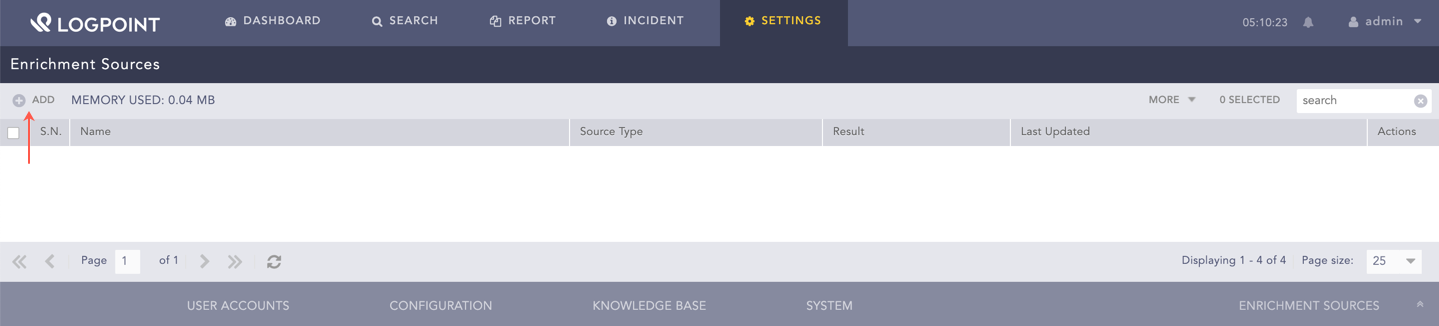
Adding an Enrichment Source
Select the CSV option.
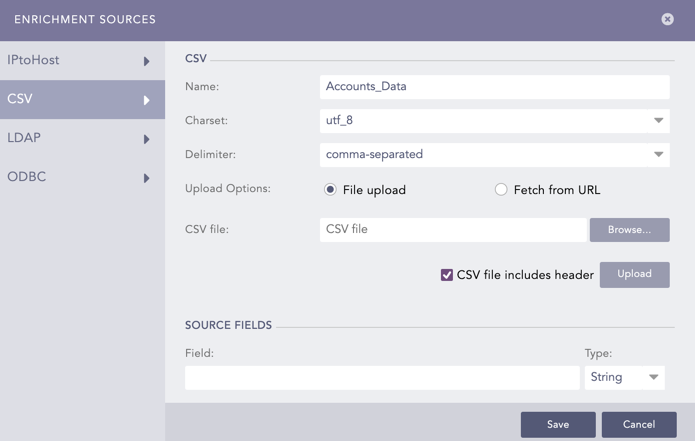
CSV Enrichment Source
Enter a Name.
Select the Charset.
Select a Delimiter. It is the type of data included in the CSV file.
Select an Upload Options.
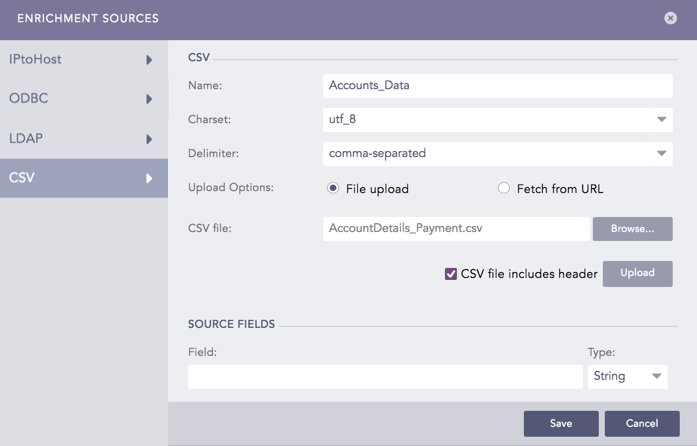
CSVEnrichmentSource - File Upload
7.1. Select File upload to provide a CSV file. Click Browse to search for a CSV file and click Upload.
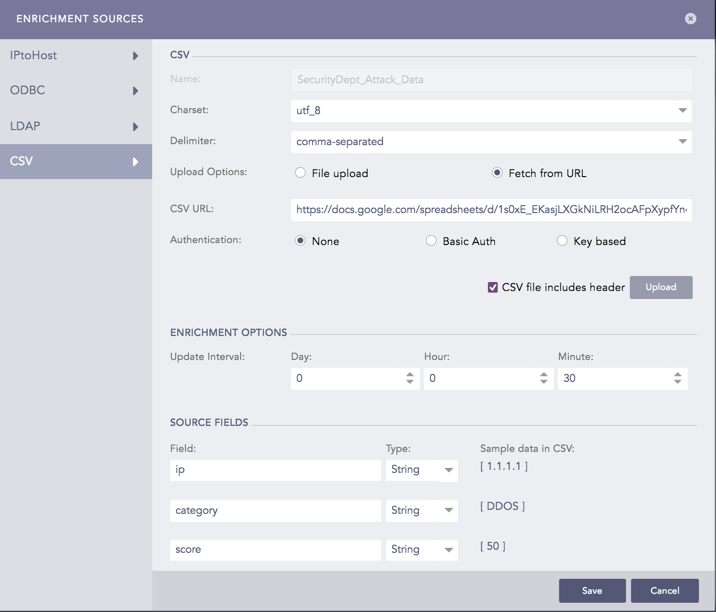
CSVEnrichmentSource - Fetch from URL
7.2. Select Fetch from URL to upload a URL link to the CSV file.
7.2.1. Enter the CSV URL that links to the CSV File.
7.2.2. Select an Authentication method.
7.2.2.1. Select None if the provided CSV URL requires no authentication.
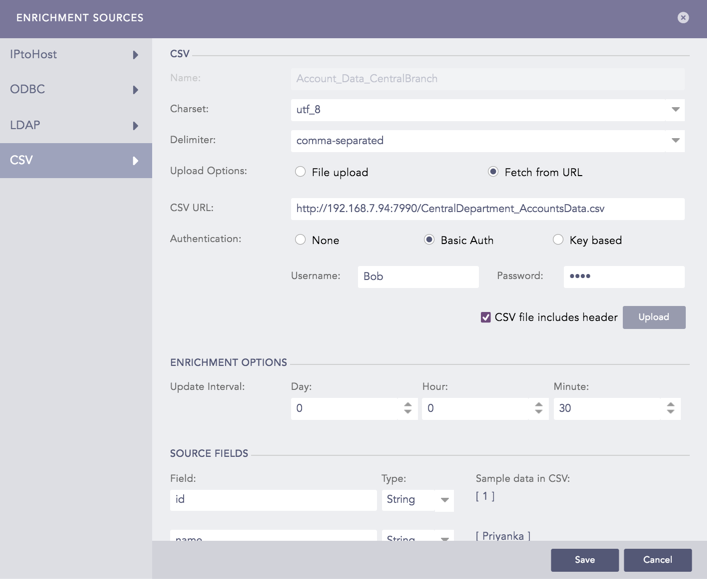
CSVEnrichmentSource - URL With Basic Authentication
7.2.2.2. Select Basic Authentication if the provided CSV URL requires basic authentication. You need to provide the basic authentication parameters, Username and Password, to access the URL.
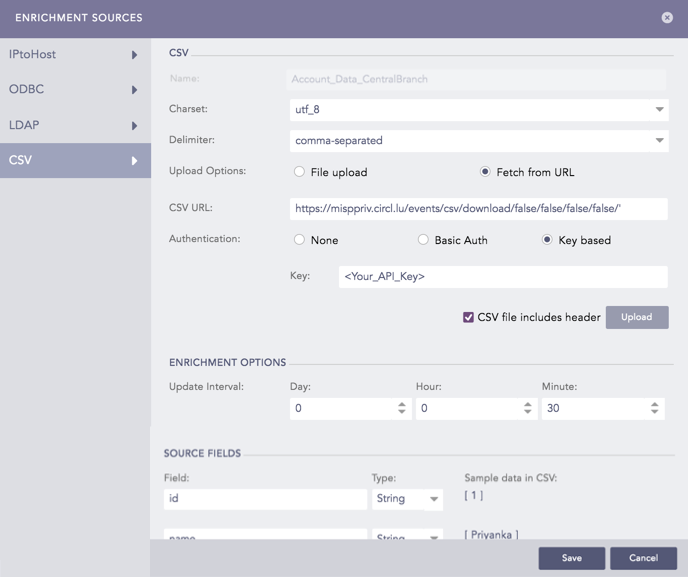
CSVEnrichmentSource - URL With Key Based Authentication
7.2.2.3. Select Key Based Authentication if the provided CSV URL requires key-based authentication. You need to provide your API Key to access the CSV File.
7.2.3. In the Enrichment Options section, enter an Update Interval.
7.2.4. Click Upload.
Note
If the HTTPs certificate provided by the CSV URL is invalid, you must unselect the Enforce HTTPS certificate validation from
Settings >> System >> Plugins >> CSVEnrichmentSource >> Manage. The application invalidates the root certificate sent by the server if one of the three conditions matches:i. Certificate hostname does not match with the hostname of the CSV URL.
ii. The Certificate Revocation List (CRL) indicates that the certificate has expired.
iii. An unrecognized Certificate Authority (CA) signed the certificate.
Select CSV file includes header if the CSV file contains field headers. If the file does not contain field headers, the application assigns default header names as Column1, Column2 … ColumnN, where N is the number of columns in your CSV file.
The Source Fields section displays the field headers of the CSV file along with the sample data.
Select the Type of the sample data from the drop-down menu.
Click Save.
Note
The loading icon in the LogPoint’s UI disappears when the URL fetch time for CSV file exceeds 5 minutes. If you click Save or Cancel during this interval, the corresponding warning message pops-up. The continuation of the fetch process is indicated by the message displayed.