
The Sync setting item allows you to export and import various configurations which can be synchronized in LogPoint. It consists of primary and secondary settings. The main purpose of the sync function is to export configurations from one LogPoint and import it to another, so that you can replicate the same configurations in other LogPoint(s) without having to create or configure them again.
The following settings items are available for sync.
Primary Settings |
Secondary Settings |
|---|---|
Device Groups |
Devices |
Normalization Packages |
Repos |
Normalization Policies |
Log Collection Policies |
Processing Policies |
|
Enrichment Policies |
|
Labeling Rules (Search Labels) |
Go to Settings >> System Settings from the navigation bar and click Sync.
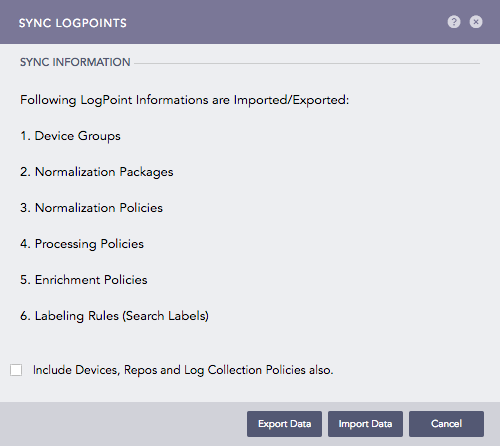
Sync LogPoints
Select the Include Devices, Repos and Log Collection Policies also checkbox if you want to include their configurations as well.
Click Export Data or Import Data as per your requirement.
Export Data: All the selected configurations are downloaded in your machine in a .json file. You can save and upload this file into another LogPoint to replicate all the settings and configurations of the former LogPoint.
Note
LogPoint includes various additional configurations in the downloaded JSON file. For example:
All the configurations of the User Accounts page except the Incident User Groups.
All the configurations of the Configuration page except the Distributed Collectors, Raw Syslog Forwarder, Distributed LogPoints, and Export Management.
All the configurations of the Knowledge Base page.
Import Data: Use this option to import the configurations specified in a JSON file exported and saved previously.
Click Import Data to open the Import LogPoint Data panel.
Browse for the JSON file downloaded earlier and click Upload.
After successfully importing the data, all the settings saved in the uploaded file are replicated in your machine.
Warning
Before importing the configurations, you should install the CSV Enrichment Source Plugin and configure the enrichment source with the same CSV source file in the same way as in the LogPoint being synced.
Likewise, you should also install the ODBC Enrichment Source Plugin, LDAP Enrichment Source Plugin, and Threat Intelligence Enrichment Source Plugin, and should have the exact configuration in each source.
Note
While using the Import Data option, you can manually remove the configurations from the JSON file according to your requirements. However, be cautious so as not to remove important data.