
Evaluates the maximum and minimum value of numeric or string argument.
Accepts an arbitrary number of arguments as input and returns the maximum of any numeric or string argument. The values of arguments get converted into ASCII (American Standard Code for Information Interchange), so a string is greater than a number.
Syntax:
| process eval("identifier=max(X, ...)")
Example:
| process eval("Maximum_datasize=max(received_datasize,sent_datasize)")
| fields received_datasize, sent_datasize, Maximum_datasize
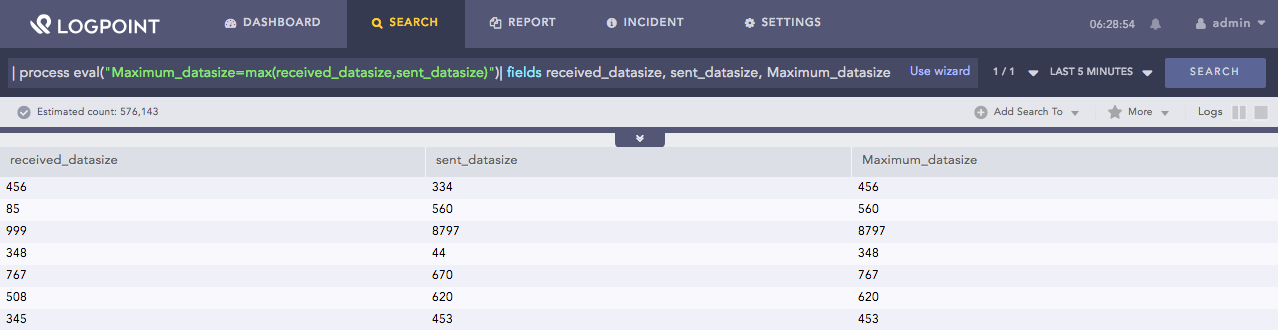
Using max function
Here, the query returns the highest value of the received_datasize and sent_datsize fields in the Maximum_datasize identifier.
The fields command displays the value of received_datasize, sent_datasize and Maximun_datasize in a tabular form.
Accepts an arbitrary number of arguments as input and returns the minimum of any numeric or string argument. The values of arguments get converted into ASCII, so a string is greater than a number.
Syntax:
| process eval("identifier=min(X, ...)")
Example:
| process eval("Minimum_datasize=min(received_datasize,sent_datasize)")
| fields received_datasize, sent_datasize, Minimum_datasize
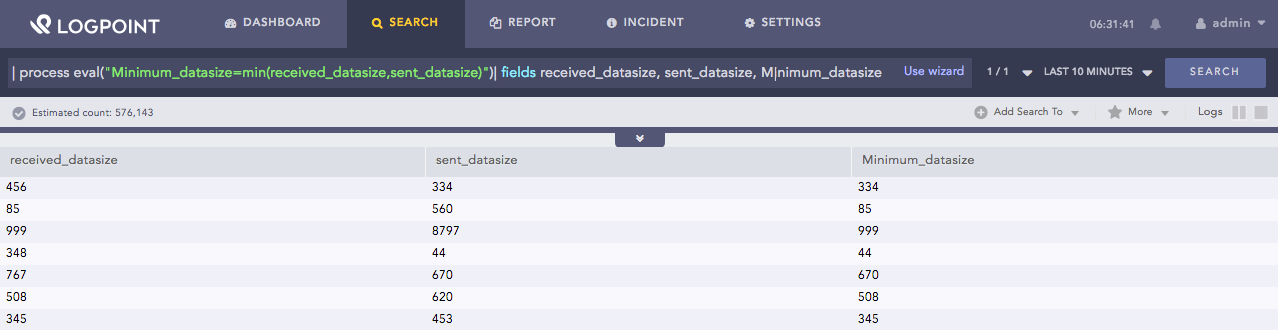
Using min function
Here, the query returns the lowest value of the received_datasize and sent_datsize fields in the Minimum_datasize identifier.
The fields command displays the value of received_datasize, sent_datasize and Minimum_datasize in a tabular form.